What the word thermo actually tells you
Thermo-aspen is heat-treated aspen. Thermory describes a controlled heat-and-steam process that reduces moisture absorption and improves dimensional stability. Its method depends on the wood and application.[1][2]
That explanation helps you interpret a material name, but it does not identify the particular boards in a cabin. The supplier and treatment belong in the specification conversation, alongside the finish you will actually receive. Ask how the proposed lining is identified and which documentation accompanies it.
The cabin specification names thermally treated aspen for the interior lining, but it does not identify Thermory as the supplier or establish a particular treatment cycle. A careful buyer keeps those statements separate. You can appreciate the material while still asking which boards and finish are included in your own offer.
Start with the room, then look at the boards
Picture a hypothetical Friday evening. The garden has gone quiet. You step inside, put your towel down and let your eyes adjust to the light. Before you notice a technical specification, you notice a room: its colour, the view through the glass and the way the timber surfaces belong together. This imagined scene is a way to think about design, not an account of a customer's experience.[3]
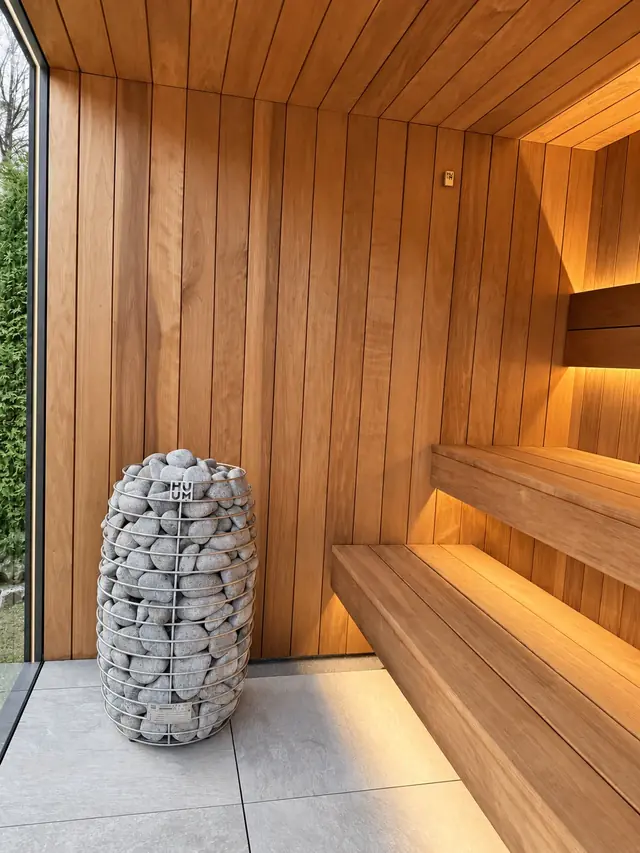
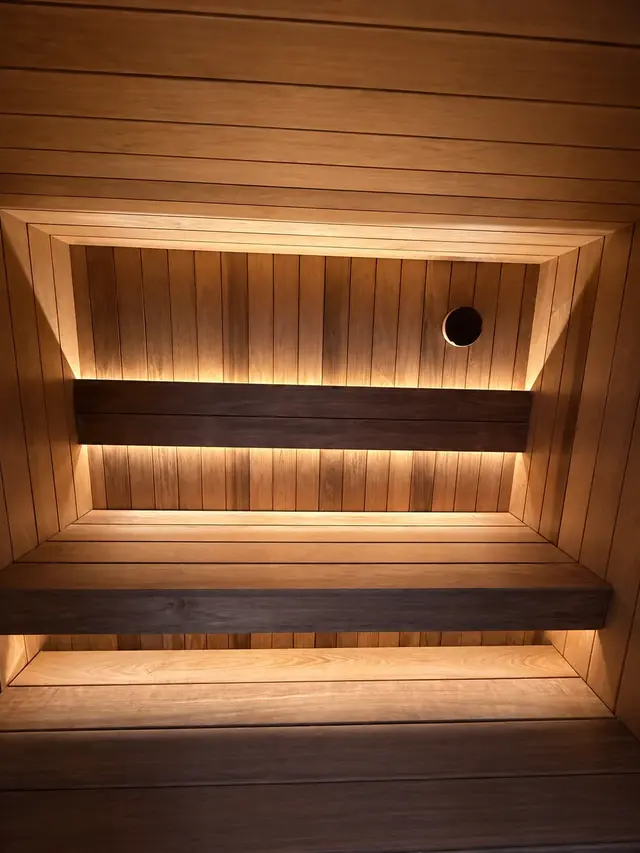
Thermory's thermo-aspen panel description identifies a golden-brown colour. The supplied cabin photographs let you consider the actual interior separately. Look at the grain, the changes in tone between boards and the relationship between the lining and the benches. Screens, lighting and photography change how colour appears. If a precise match matters, ask about a current sample rather than choosing from a single bright photograph.
Comfort is more than a wood name
A good material description should help you ask better questions, rather than promise that one word solves everything. Consider where your back rests, where you place your feet and whether the seating arrangement suits the people who will use it. Think about reaching a towel, moving around the heater and settling into a position without feeling squeezed. Those are questions about the complete room.
It would be misleading to turn thermo-aspen into a promise that every surface stays cool or can never become uncomfortable. Actual conditions and the operating instructions still matter. Ask to see the current seating layout and follow the supplied guidance for use. The appeal is not a magical material. It is a considered timber interior that you can assess alongside the layout, the lighting and the rest of the specification.
The interior is one part of a layered cabin
The specification makes more sense when you stop reading it as a list of impressive nouns. Thermally treated aspen is the named interior lining. The same documents also list a C24 timber structure, birch-plywood sheathing, insulation, barrier layers and glazing. These components have different jobs. A visible board is not the whole wall, just as a handsome coat is not the whole person wearing it.[1]
For the supplied models, the documented insulation thickness is 100 mm at the walls and ceiling and 150 mm in the floor. Those figures describe the specified layers; they do not establish a heating bill or a measured warm-up time. Ask for the current construction and equipment details in your project offer. Understanding how the parts fit together is more useful than assuming the interior timber alone explains the cabin's performance.
A small comparison that helps with choosing
Imagine two hypothetical garden-sauna interiors with the same floor area. In the first, you like the wood colour but cannot clearly see the seating or the entrance. In the second, the photographs show those details and the seller can explain the proposed finish. The second gives you more to work with, even before you decide which appearance you prefer. This is a buying exercise, not a comparison with a competing product.
Try the same exercise with your own shortlist. Cover the brand names for a moment. Can you identify the actual interior material? Can you tell which model is pictured? Do you understand the layout, and do the photographs support the description? Then uncover the names and look at the specification again. A premium impression becomes more convincing when you can connect the atmosphere to real, identifiable details.
Keep the beauty; understand the care
Natural material deserves a realistic ownership conversation. Thermory's panel guidance says that wood needs regular maintenance and that installation quality matters. That is a useful counterweight to the idea that a treated board should be maintenance-free. It is still sensible to ask for care instructions for the actual lining and any surface finish supplied with your cabin.[3]
Before buying cleaners, oils or other products, establish what has already been applied and which products the supplier recommends. Ask how the sauna should be aired and dried after use, and which changes in appearance deserve attention. Avoid borrowing a routine for a different timber or finish simply because both products are called sauna wood. A clear care guide makes ownership easier to picture: enjoying the room, looking after it and knowing where to ask when something is unclear.
Choose the space that fits your evening
Both Aura and Aura Lounge list thermally treated aspen for the interior lining. The practical difference begins with the arrangement of the spaces. Aura focuses on the sauna room in a compact cabin. Aura Lounge adds a separate lounge, giving the visit another place to begin or continue. The right starting point depends on how you imagine using the cabin, not on collecting the longest list of features.[1][4]
Return to that imagined Friday evening. Would you step straight from the garden into a simple sauna routine, or would a separate room make the occasion feel more complete? Explore the photographs for the model that fits that picture. When you are ready, ask for a project offer confirming the actual materials, equipment and site requirements. The most appealing sauna is one whose atmosphere you enjoy and whose details you understand.
Sources & further reading
- Aura technical specificationsAura Cabin · supplied product documentation, 18 October 2026 · Sources checked on
- Thermal modification of wood: how Thermory thermowood is madeThermory · manufacturer technical explanation · Sources checked on
- Wall panel SRP Thermo-aspenThermory · manufacturer material and maintenance description · Sources checked on
- Aura Lounge technical specificationsAura Cabin · supplied product documentation, 18 October 2026 · Sources checked on
Already have a place in mind?
A few thoughts can become your first project brief.