First, put the wood in the right place
The current Aura and Aura Lounge specifications list Brazilian cumaru hardwood together with black Ruukki Plus Matt RR33 metal for the exterior. They list thermally treated aspen for the interior. Cumaru sauna cladding therefore describes the outside material here; it is not a statement that the same boards form the sauna benches. Both documents say that the project offer confirms the final finishes and equipment.[1][2]
That distinction makes a conversation with a supplier easier. Ask for a marked elevation showing which surfaces receive timber and which receive metal. A material list names ingredients; an elevation shows the recipe. Look particularly at the entrance, the sides visible from the house and the corner facing a neighbouring garden. These are practical viewing priorities, not a claim about an unconfirmed cladding arrangement.
A trade name is the beginning of identification
Researchers Richter and Dallwitz describe Dipteryx odorata as tropical South American timber with interlocked grain. Their reference explains a species; it does not identify the boards delivered for your project.[3]
Think of the difference between a menu and the label on a particular ingredient. Knowing a name helps you start asking informed questions, but it does not tell you which shipment a board came from. Request the botanical identification used by the supplier and the material record attached to your order. You do not need to become a wood anatomist to buy a sauna. You need an understandable description that stays consistent between the quotation, approved sample and delivered product. If two documents use different names, ask for the relationship to be explained before treating them as interchangeable.
Choose a palette rather than one perfect pixel
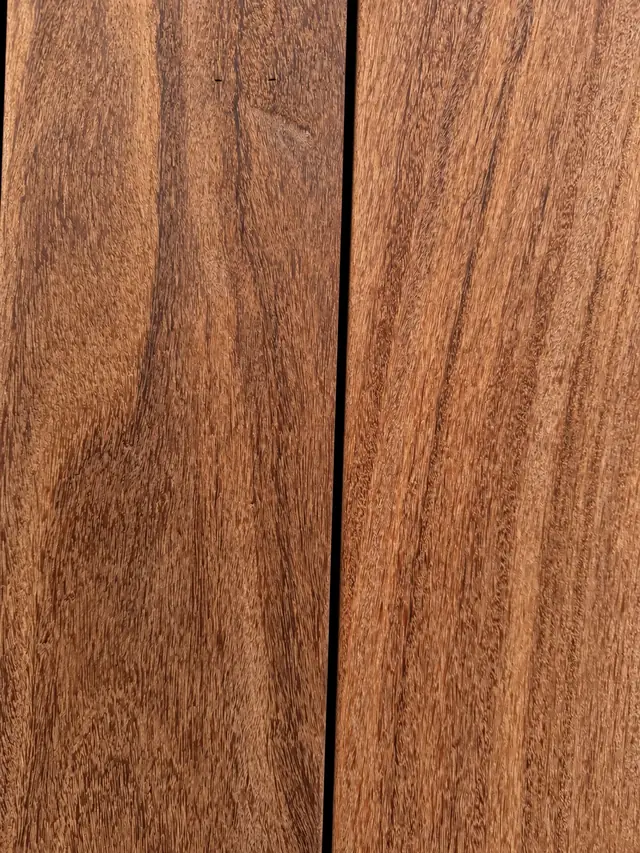
ITTO describes cumaru heartwood colours ranging from yellow-brown to reddish brown, with fine dark veins. That is background about the wood, not a colour guarantee for a cabin.[4]
Our design suggestion is to compare an actual proposed sample with the other surfaces around your sauna. Place it near your paving, fence and house facade. Look in daylight and under the garden lighting you intend to use. A phone photograph is useful for remembering a combination, but should not be the sole approval reference. Ask which sample represents the proposed finish, and whether several boards can be shown together. You are choosing how a small building joins your garden, rather than ordering every board to resemble a single photographed rectangle. Allow your preference to be specific: calmer contrast, warmer colour or a stronger dark outline.
Separate appearance, protection and promises
A finish discussion is clearer when it answers three different questions: what appearance is intended, which product will actually be applied, and what care instructions accompany it? The available cabin specification does not establish an exact cumaru coating or a maintenance interval. We cannot turn the timber name into a promise of maintenance-free ownership, or prescribe an oil without knowing the proposed finish.
Ask for the coating name, its applicable instructions and any warranty conditions relevant to your order. If the proposed exterior is uncoated, ask for that to be written down too. Keep a photograph of the approved sample with the order documents. It gives you a useful starting point for later questions. Ask the supplier how to distinguish an acceptable change in appearance from something needing inspection, rather than relying on a generic internet photograph or an impressive service-life number.
A hypothetical walk from the kitchen to the sauna
Imagine a family considering a cabin at the end of a short garden path. This is a hypothetical planning example, not an account from an owner. From the kitchen window they mainly see one side; from the terrace they see the entrance and glass. Their first instinct is to compare close-up timber photographs. A more useful first step is to draw those two sightlines and mark the surfaces they will actually notice.
They ask for the timber-and-metal arrangement, a proposed finish sample and a view of the entrance. Then they compare that sample beside their existing fence. The exercise does not predict performance or future colour. It helps them give a clear brief: the sauna should feel connected to the terrace when seen from the house. A small decision about the facade becomes a decision about the evening journey, rather than a contest between attractive sample pictures.
Provenance deserves its own question
The product documents describe the exterior timber as Brazilian cumaru. That description does not, by itself, establish a particular forest, supplier chain or FSC or PEFC certificate for your order. Ask what origin and traceability documents are available for the material actually proposed. If certification matters to your decision, request the applicable documentation and check that it covers the product being supplied.
An attractive board cannot answer these questions on its own. Nor does a timber reference website prove that a specific cabin has a particular environmental credential. Keep appearance and documentation as two separate approval steps. You can like the sample and still ask for better records. A useful response names the relevant material and explains the evidence in plain language. An unsupported adjective such as responsible or premium should lead to a question, not substitute for an answer.
Bring the detail back to the way you want to use it
Aura is the compact sauna model; Aura Lounge adds a separate lounge. The exterior material choice is therefore only one part of choosing between them. Consider whether your evening ends with a walk back indoors or includes time in a separate room. Then think about which side of the building you want to see during that routine. Neither choice needs an elaborate garden to feel intentional.
You can begin an enquiry with a garden photograph, the model you are considering and one sentence about your preferred timber appearance. Ask for the proposed facade arrangement and finish to be confirmed in the offer. There is no need to arrive with every detail decided. The aim is a cabin you can picture using, supported by a material specification you can understand. The final project offer confirms the actual equipment, finishes and site requirements.
Sources & further reading
- Aura technical specificationsAura Cabin · Sources checked on
- Aura Lounge technical specificationsAura Cabin · Sources checked on
- Commercial timbers: Dipteryx odorataH. G. Richter and M. J. Dallwitz; University of Hamburg archive · Sources checked on
- Cumaru (Dipteryx spp.)International Tropical Timber Organization · Sources checked on
Already have a place in mind?
A few thoughts can become your first project brief.