First, find the plywood on the materials list
Aura and Aura Lounge list the same sheathing material and thickness. Their specifications list thermally treated aspen separately as the interior lining. So the birch plywood and the wood you see inside the finished sauna are different entries with different jobs. Thinking of every wooden layer as “the sauna wood” would hide a useful distinction.[1][2]
Sheathing is a sheet layer in the construction, rather than the decorative name of the finished room. The product sheets establish the material, but do not provide a complete wall section showing every panel position, joint and fixing. Ask for that project detail if you want to understand the assembly. There is something satisfying about this less photogenic part of choosing a cabin: you begin to recognise a building with several coordinated layers, rather than one attractive wooden surface.
A sheet with a layered story
Plywood is made from thin wood veneers bonded together. APA explains its cross-laminated construction: neighbouring layers have alternating grain directions. That arrangement helps distribute strength and stiffness in both panel directions and improves dimensional stability compared with solid wood. It does not make all plywood identical.[3][4]
For a concrete manufacturer example, the Metsä Wood Birch datasheet describes cross-bonded birch veneers. It also distinguishes the base plywood, bonding and surface grades. That is a useful reminder that a sheet has more than one characteristic to describe. Metsä Wood is an educational example here, not a confirmed Aura supplier. Its particular veneer thickness, adhesive, approvals and performance figures must not be transferred to the cabins. The general lesson is simpler: plywood is an engineered arrangement of wood layers, not just a thick slice from a tree.
What 18 mm tells you—and what it leaves open
Eighteen millimetres tells you the specified sheathing thickness in both models. It does not reveal the panel’s full specification. APA treats panel grade, exposure suitability and design properties as separate information; its guidance also explains that mechanical properties depend on factors including panel thickness and the direction of loading.[3][1][2]
For a buyer, this makes “Is it thick?” only the first question. “Which panel is it, and how is it used?” takes the conversation further. The current Aura documents do not identify a plywood manufacturer, surface grade or bond class. Nor do they give a panel load capacity that can be inferred from 18 mm. You do not need to calculate a wall yourself. You can simply request the selected panel’s documentation and its place in the final construction detail.
Moisture resistance is a specific idea, not a magic cloak
The phrase moisture-resistant can sound like the end of the water discussion. It is better treated as the beginning of a precise one. APA explains that a bond classification concerns the adhesive bond’s resistance to moisture; it is not a measure of structural strength or resistance to fungal decay. Those distinctions appear in guidance for APA panels, not as a classification of Aura’s sheathing.[3][4]
Metsä Wood’s own birch datasheet makes another useful distinction: alongside its product’s bonding information, it notes that moisture content affects dimensions. A moisture-resistant bond and wood that responds to moisture can therefore belong to the same panel. Neither source establishes the properties of the unidentified Aura panel. They explain why calling an entire cabin layer “waterproof” would say more than its short materials description supports. Keep the plywood, the protective layers and the complete construction as separate questions.
A hypothetical conversation at the sample table
Imagine a hypothetical buying conversation with two plywood samples. Both are introduced as 18 mm sheets. One arrives with only a confident adjective; the other comes with a product identity and documents that explain its intended use. Their faces might look equally convincing. The useful difference is what you can actually check.[3]
This is an illustration, not a comparison test or a claim about two Aura options. Its point is that appearance, thickness and documentation answer different questions. A smooth face cannot tell you the bond class, and a technical label cannot explain every joint in a cabin. Instead of asking for ever grander adjectives, ask how the panel information connects to the proposed assembly. That turns a potentially bewildering materials conversation into a short, practical exchange.
Read the workshop photo as a moment in construction
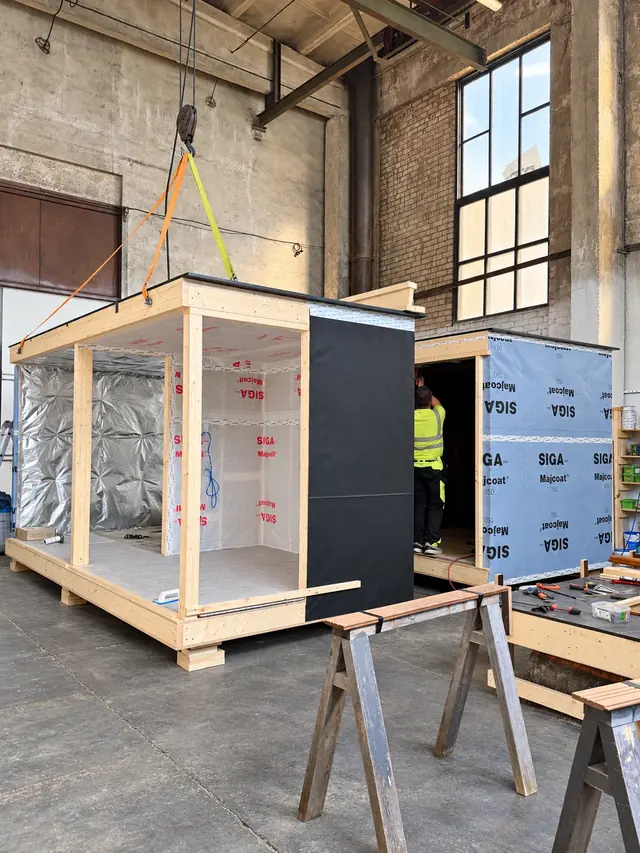
The real workshop photograph accompanying this story shows cabins during construction, with timber, sheet surfaces and protective layers still visible. It offers a different pleasure from the finished garden view: a chance to notice that the quiet room is assembled from parts. Follow those visible layers with your eye before imagining the completed interior.[1][2]
The picture is not evidence of a plywood brand, grade or bonding performance. Nor does it document every concealed part of the finished model. Use it to start a conversation, then use the specification and project drawings to answer it. “Can you show me where the sheathing sits in my model?” is a much better use of the photograph than trying to certify a panel by looking at its colour.
Choose the room around the ritual, and ask about the hidden layer
Both Aura and Aura Lounge have the specified 18 mm birch plywood sheathing. That shared entry gives you a common starting point while you consider how you want to use the cabin. Aura is the compact outdoor sauna; Aura Lounge adds a separate lounge. Perhaps you picture a short walk from the house and straight into the warmth. Perhaps your imagined evening includes time in a separate room between sessions. These are possible routines, not promises about how every owner uses the models.[1][2]
You can enjoy choosing that setting while still being curious about what is behind the lining. If either model feels like it could belong in your garden, ask Aura Cabin to explain the sheathing in its proposed construction and confirm the selected plywood documentation. The project offer confirms final equipment, finishes and site-specific requirements. A clear answer about a hidden sheet can make the visible cabin easier to understand.
Sources & further reading
- Aura technical specifications · 18 October 2026Aura Cabin · Sources checked on
- Aura Lounge technical specifications · 18 October 2026Aura Cabin · Sources checked on
- Plywood: construction, selection and bond classificationsAPA – The Engineered Wood Association · Sources checked on
- Metsä Wood Birch product datasheet · June 2026Metsä Wood · Sources checked on
Already have a place in mind?
A few thoughts can become your first project brief.