Sauna Interior Wood: How to Choose the Right Boards
Sauna Interior Wood: How to Choose the Right Boards
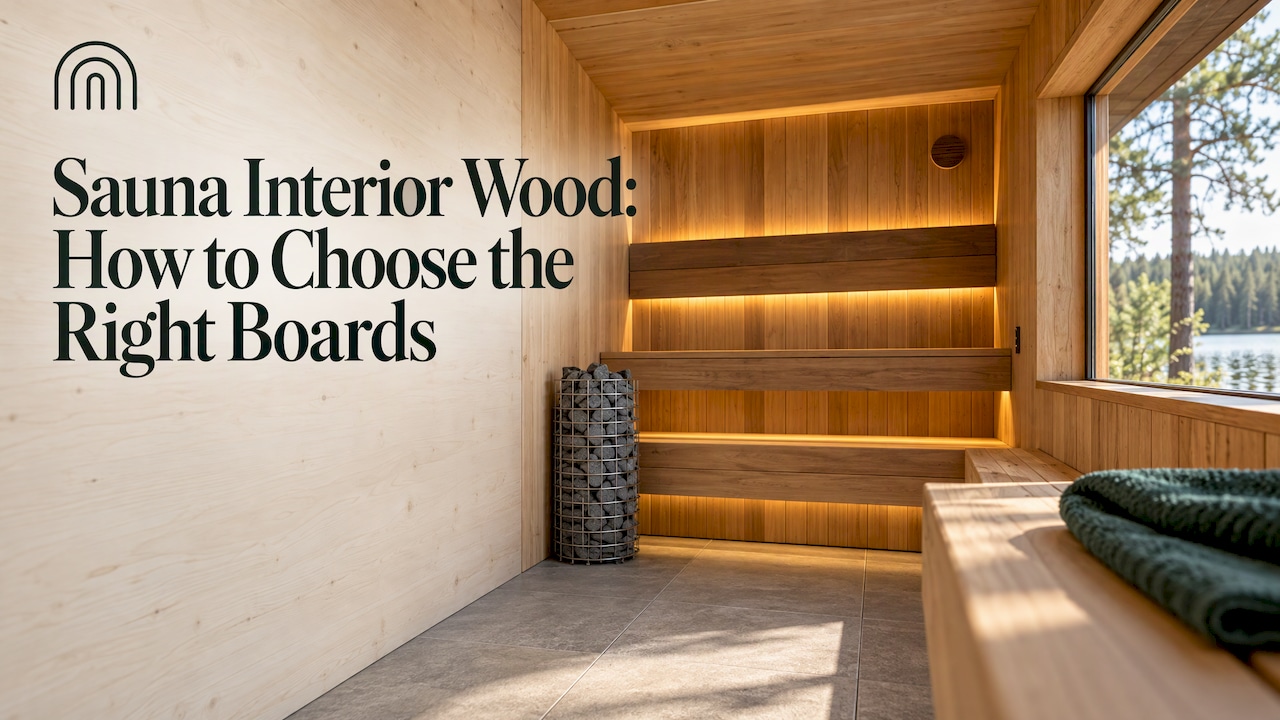
The best sauna interior wood is a pale, low-resin, fine-grained board that stays comfortable to touch, tolerates daily swings between dry heat and damp air, and looks good for years. For an outdoor electric sauna, thermally treated aspen meets that brief on the walls, the ceiling and the benches, which is why it is what we use inside our Aura cabins. The rest of this guide explains how to judge any wood you are offered, so you can compare species on what matters instead of on a name.
TL;DR
- Judge wood by the job: walls and ceiling need stability and a calm look, while benches need a surface that feels comfortable against bare skin.
- Knots and resin are the two things that make a board unpleasant at sauna temperatures, so look for clear, even boards with little pitch.
- Wood swells and shrinks with humidity. A well-dried or thermally treated board moves less, so gaps and cupping are less likely.
- Thermally treated aspen is our choice for the interior of every Aura and Aura Lounge cabin, paired with a HUUM heater.
- Pine can be used in a sauna, but it needs the most care over resin and knots, so grade matters more than the species label.
Table of Contents
- What the inside of a sauna has to survive
- Walls and ceiling versus benches
- The qualities that make a good sauna wood
- Common sauna woods compared by type
- Can you use pine in a sauna?
- Basswood, mahogany and other names you will see
- How to choose: a short decision guide
- Keeping the wood in good shape
- Where our Aura cabins fit
- FAQ
- Sources
What the inside of a sauna has to survive
A sauna interior is a hard environment for timber. Within an hour a room goes from outdoor temperature to heat well above what you would ever expect in a living room, then cools and often takes on moisture from steam or from people. Then the cycle repeats the next evening. The wood has to handle that rhythm without twisting, splitting, weeping sap or becoming too hot to sit on.
A useful way to think about it: a species name is a starting point, not a guarantee. One technical wiki on sauna timber makes the point that a usable specification combines the verified identity and grade of the wood with its density, moisture movement, surface quality, finish and sourcing, and that the species name alone guarantees none of comfort, durability or safety. In plain terms, a good board of an average species beats a poor board of a famous one.
So before comparing woods, decide what you are asking each part of the sauna to do.
Walls and ceiling versus benches
The room has two kinds of wood surface, and they have different demands.
Walls and ceiling
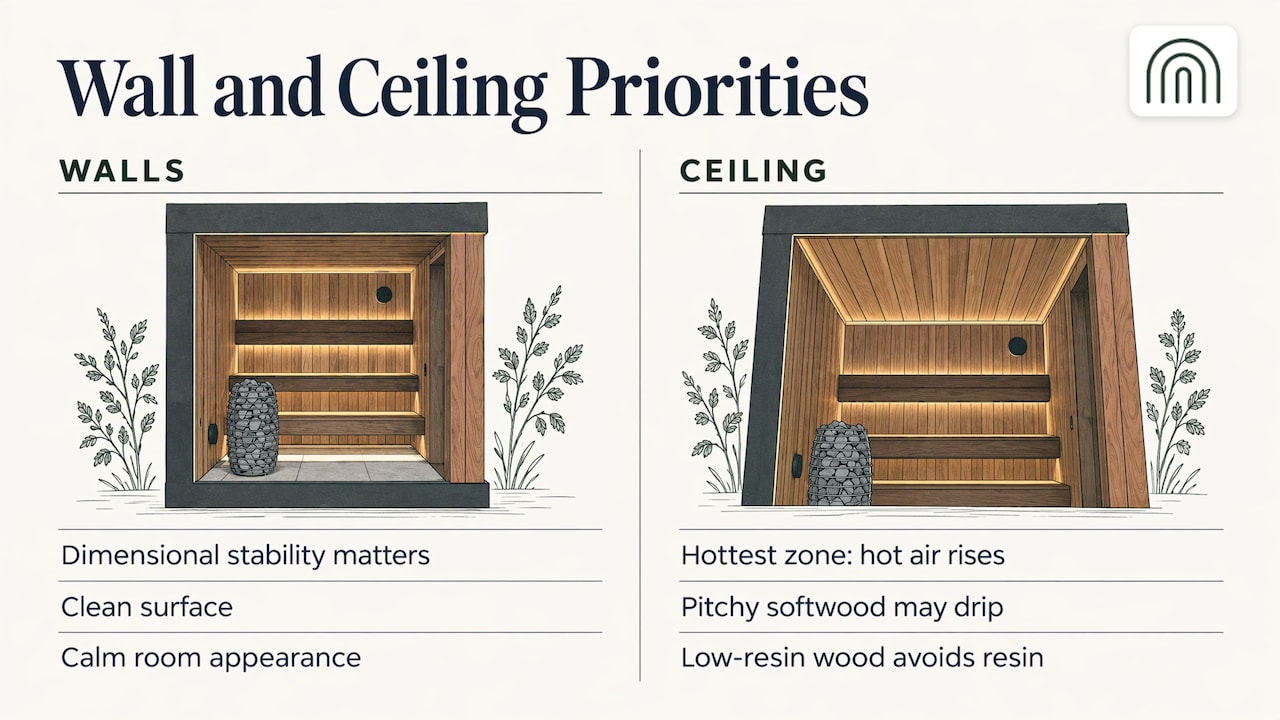
You touch these rarely, so comfort against skin matters less. What matters is dimensional stability, a surface that stays clean, and a look that makes the room feel calm. Boards here are usually tongue-and-groove, which means each board has a ridge on one edge and a slot on the other so they lock together. If the wood moves a lot with humidity, those joints open and close over the seasons. We go deeper on this in our piece on what humidity does to sauna boards.
The ceiling is the hottest zone, because hot air rises. Resin is the issue there: pitchy softwood can bead and drip when the room is hot. A low-resin wood avoids that.
Benches and backrests
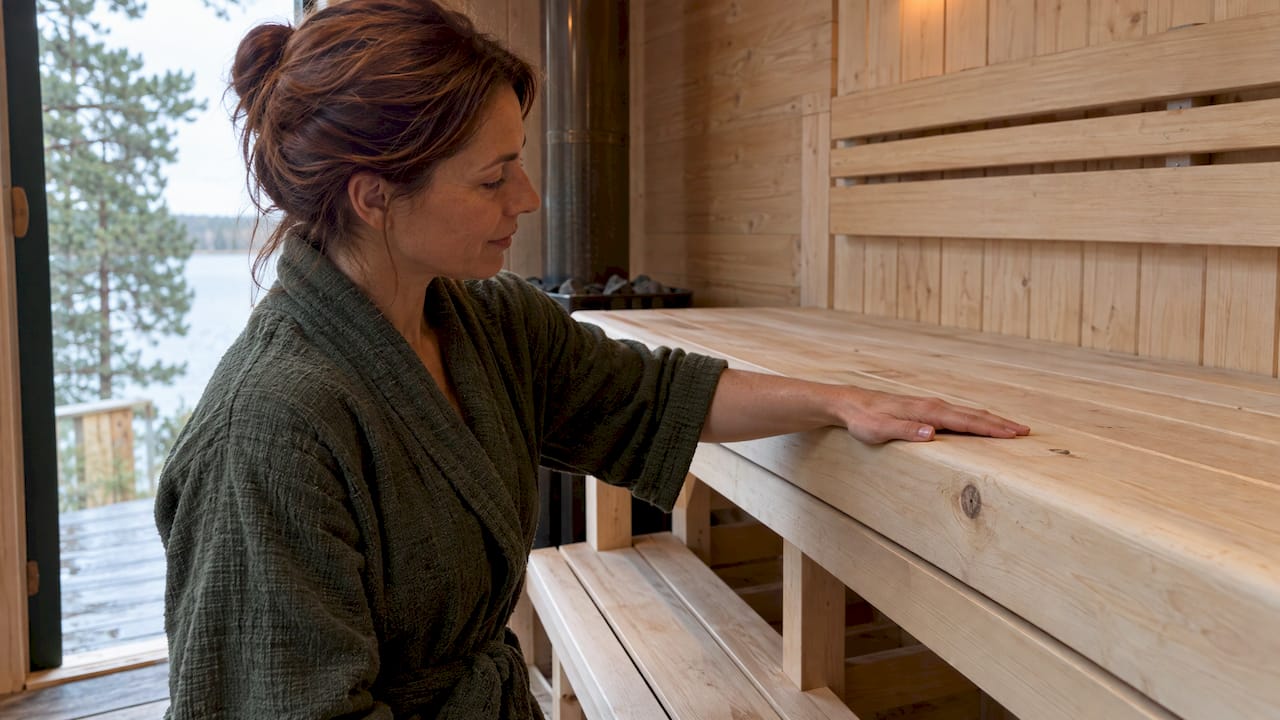
Benches are where bare skin meets timber, so the surface temperature you feel is what counts. Two boards in the same hot room can feel quite different to sit on. Lighter, less dense wood tends to feel gentler than heavy dense wood, and a knot in a bench board can feel noticeably hotter than the clear wood around it. One timber analysis calculates that knots conduct heat two to four times better than clear wood, which is why bench boards are normally sold as clear or knotless. Our article on why two warm surfaces feel different explains the same effect from the user’s seat.
The practical rule: spend your attention on bench boards first. Run a hand over them and look for knots, rough patches and sharp edges. Rounded edges and sanded faces matter as much as the species.
The qualities that make a good sauna wood
When you strip away the marketing, six properties decide how a wood behaves in a sauna.
- Low resin. Pitch can ooze when hot. It is sticky, it can mark skin and towels, and it can smell sharp. Woods with little or no resin avoid the problem.
- Few or no knots. Knots are denser than the surrounding wood, can loosen, and can feel hotter on skin. Clear boards cost more but are much more pleasant.
- Low to moderate density. Lighter woods generally feel more comfortable on a bench. Very dense woods suit cladding better than seating.
- Dimensional stability. Wood is hygroscopic: it takes up and gives off moisture with the surrounding air. The less it moves, the tighter your walls stay. The wiki above notes that a sauna that cycles on and off does not necessarily reach moisture equilibrium during a session, so the board is always adjusting a little.
- A neutral, light look. Pale wood brightens a small room and reflects the soft light of a sauna evening. Darker wood gives a cozy, moody feel.
- Clean, untreated surface. Sauna wood is usually left unvarnished, because coatings can soften or smell when hot. Look for boards that are simply sanded and ready.
Availability and cost sit alongside these. A wood that is common in your region is easier to replace and repair later.
Common sauna woods compared by type
No single wood wins on every measure. Here is how the main families behave, described by what a homeowner will notice.
Swipe left or right to see all columns.
| Wood type | Look | Resin | Bench comfort | Typical role |
|---|---|---|---|---|
| Thermally treated aspen | Pale to honey-brown, even grain | Very low | Gentle, smooth | Walls, ceiling and benches |
| Untreated aspen | Pale, fine grain | Very low | Gentle | Benches and cladding |
| Western red cedar | Warm reddish tones, aromatic | Low | Gentle | Cladding, often outdoors |
| Hemlock | Light, clean, subtle grain | Low | Good | Interior cladding |
| Spruce and pine | Light yellow, visible knots | Higher | Depends on grade | Cladding, budget builds |
| Abachi (African obeche) | Very pale, light | None | Among the coolest-feeling | Benches |
| Dense tropical hardwoods | Dark, rich | Varies | Hot to sit on | Exterior cladding |
The abachi row reflects a species comparison that lists it as one of the lightest and coolest-feeling bench woods, with no resin at all.
Aspen
Aspen is a pale, fine-grained hardwood with very little resin, and it has long been used for sauna benches and interiors in Northern Europe. It does not carry the sharp smell of pitchy softwoods, so the room smells of warm wood and not of sap. For a family sauna, that softness against the skin is what you notice first.
Thermally treated aspen
Thermal treatment means the timber is heated to a high temperature in a controlled process, which changes its character. In sauna use the result is a wood that is darker, with a warm honey tone, and that is made to hold its shape better when humidity changes. That is why we build our cabins with it: it combines the gentle touch of aspen with the steadiness you want from walls and ceiling in a garden sauna. Our article on why thermo-aspen belongs inside a garden sauna covers the reasoning in more detail, and the care routine after use is short and simple.
Cedar and hemlock
Cedar brings a warm color and a distinctive aroma, and it is a familiar sight in North American saunas. Hemlock is lighter and quieter in look. Both are softwoods, so grade matters: ask for clear boards with few knots, especially for anything you will sit on.
Spruce and pine
Both are widely available and affordable. They carry more resin and more knots than the other woods above, so the grade of the board decides how they perform. We cover pine more fully below.
Tropical hardwoods
Very dense woods are strong and weather well outdoors, so they appear on the outside of saunas more than inside. We use that logic for the exterior: see our piece on cumaru cladding, the wood outside the warmth. Inside, where you sit and lean, lighter woods feel better.
Can you use pine in a sauna?
Yes, pine is used in saunas, and plenty of log-built and budget saunas are lined with it. The caveat is resin. Pine contains pitch pockets that can weep when the room is hot, and pine boards often carry knots. On a wall that is mostly a cosmetic issue. On a bench it is a comfort issue, because a resinous knot can be a hot, sticky spot under bare skin.
If you are considering pine, the practical checklist is short:
- Choose clear, kiln-dried boards, and keep knotty boards for walls out of reach.
- Look closely at the ceiling boards and the area near the heater, where heat is highest.
- Plan for benches in a different, lower-resin wood.
That last point is the reason many buyers end up preferring a low-resin hardwood for the whole interior: one wood, one look, no resin to manage.
Basswood, mahogany and other names you will see
Basswood is a pale, soft, very low-resin wood that is gentle on the skin, so it is often discussed as a bench option. Mahogany is a dense, dark tropical wood. Because it is dense, it is a better fit for decorative or exterior work than for the surface you sit on. If you are weighing the two for a bench, the same rules apply as for any wood: lighter and clearer feels better, and a clean, sanded finish matters more than the name. For a whole-room interior, a single consistent wood will look more intentional than a mix.
How to choose: a short decision guide
Bring the criteria together by asking these questions in order.
- How will the sauna be used? A family sauna used every week needs forgiving, comfortable surfaces. A guest sauna at a holiday home or small hotel sees more varied users and needs a surface that looks good in photos and stays tidy.
- Indoor or outdoor? An outdoor sauna swings through more temperature and humidity than an indoor one. The interior wood should be stable, and the exterior should be built for weather. A factory-built cabin lets both be planned together.
- What look do you want? Pale and Scandinavian, or warm and honey-toned? Thermally treated aspen leans warm, and it darkens gently with use.
- How much care do you want to give? A low-maintenance interior is unvarnished, needs a quick wipe and some air after use, and does not need oiling.
- What is available and how is it built? Check the grade, drying and finish, not just the species name.
Finally, remember what is behind the visible boards. A sauna wall is a layered structure, and what sits under the cladding affects how the whole room behaves. We explain one such layer in birch plywood in sauna construction.
Keeping the wood in good shape
Good habits matter as much as the wood.
- Let the room dry. After your last round, leave the door ajar so the boards release moisture before the cabin closes up.
- Wipe benches. A damp cloth removes sweat and salt. Use plain water or a mild sauna-safe cleaner, and avoid anything strongly scented that the hot wood could take up.
- Use a towel. Sitting on a towel protects the bench surface and keeps skin comfortable.
- Avoid coatings inside. Varnish and strong oils are not what hot sauna wood needs.
- Expect small changes. A little color deepening and light grain movement with the seasons is normal for natural wood.
Where our Aura cabins fit
If you want the interior question settled by someone who has already made the choice, that is what we do. Aura cabins are factory-built in Latvia with thermally treated aspen inside and a HUUM electric heater. Aura is a compact sauna room, and Aura Lounge adds a separate changing and relaxation space, which suits families, holiday homes and small hotels that want guests to have somewhere to cool down and talk. Each cabin is tailored to the customer’s specifications, and we plan delivery, unloading, installation and site preparation around your location.
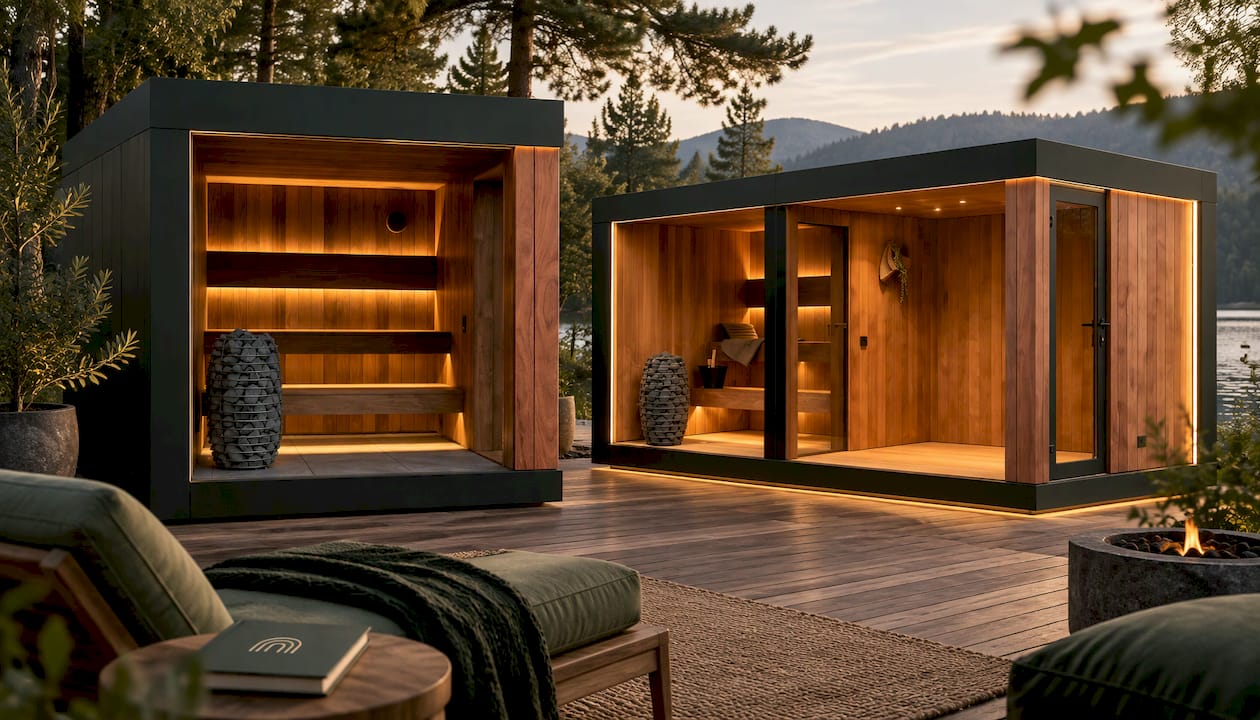
You can see the Aura compact sauna and the Aura Lounge on their own pages, or start from our main page to request a quote for your garden or property. If you are still deciding between heater types, our guide to wood, electric, smoke and infrared saunas sets out the differences.
FAQ
What is the best wood for a sauna interior?
The best choice is a pale, low-resin, clear wood that stays comfortable to the touch and stable in humidity. Thermally treated aspen fits that description and is what we use for the walls, ceiling and benches of our cabins. Its look is warm and even, and it needs only simple care.
What wood should I use for sauna walls?
For walls and ceiling, prioritize stability, a calm look and low resin. Tongue-and-groove boards in thermally treated aspen give a tight, even surface that is built to cope with changes in humidity. The grade and drying of the boards matter as much as the species.
Can I build a sauna with pine?
Yes, pine is widely used, but it has more resin and knots than low-resin hardwoods, so grade is critical. Choose clear, kiln-dried boards and keep knotty pieces away from seating and from the area around the heater. Many owners prefer a low-resin hardwood for benches.
Does the wood need to be treated or varnished inside?
No. Sauna interiors are normally left bare, sanded and unvarnished, because coatings can soften or smell in the heat. Thermally treated boards are made ready for use as they are, and a wipe-down and some airing after use is all the care they need.
Why do some benches feel hotter than others?
Density and knots are the main reasons. Lighter, clear wood feels gentler than dense wood, and a knot can feel hotter than the board around it. Choosing clear, sanded boards for benches gives the most comfortable seat.
Sources
- Wood species for saunas, RUVARO Sauna Wiki
- Sauna Wood Thermal Conductivity, ThermalFinn
- Best Wood for Sauna, ThermalFinn