A burst of steam and a board keep different time
Air humidity can change quickly during a sauna session. That tells you about the air at that moment. It does not say how much moisture the board has gained or how far that moisture has reached. The Wood Handbook describes equilibrium moisture content as the point at which wood under given conditions is no longer gaining or losing moisture. Both air humidity and temperature matter to that balance.[1]
Think of the session and the drying period as two parts of the same story. A short humid spell can be followed by hours in different conditions. The wood does not instantly reach a new balance each time there is a pour. That is why comparing the lining while the room is in use with its appearance on a dry day can raise a good question without yet giving you a diagnosis. A cabin sitting unused can also spend days in air that is wetter or drier than it was the week before. If a joint first catches your eye after a spell away, keep the date and conditions in your notes. The last pour might be only one part of the picture.
A thought experiment with two pencil marks
Picture a spare board on a workbench, with one pencil mark drawn along its grain and a second across its width. In this thought experiment the moisture content of the wood changes. The line across the board is the one you would usually watch first. Wood typically changes much more across the grain than along it, and how the board was cut can influence the amount and shape of the change.[1]
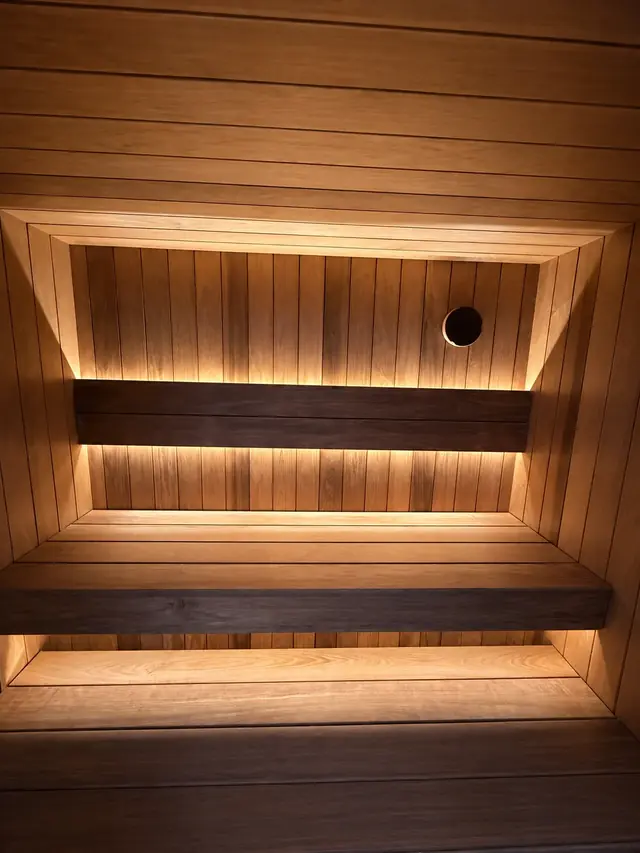
Now think of neighbouring boards meeting on a wall. A change in width can affect the appearance of their seam, but you cannot read the amount of movement from a single photograph. The image of the Aura backrest is a useful way to see where the boards meet. The dark edges pick out the joints; they are not a record of how any of those joints behaved over time.
Why heat treatment belongs in the conversation
Both Aura technical sheets specify thermally treated aspen for the interior lining. Heat treatment is relevant to moisture behaviour, but it does not give you a universal number for movement. The International ThermoWood Association handbook shows that tested spruce reached a lower equilibrium moisture content after particular thermal treatments. That is a useful example of the effect in a documented species and process.[2][3][4]
Spruce is not the aspen specified for these cabins. The study does not establish the treatment class, manufacturer, profile or expected seam width of the lining in Aura or Aura Lounge. If the detail matters to your decision, ask for the proposed lining product and its installation information in the final offer. Treat an attractive sample as a way to see the surface, with the written details supplying the rest of the answer.
Make the drying period part of the evening
Picture the moment when the last towel goes back to the house and the cabin is left to dry according to its handover instructions. Knowing that routine before your first evening is useful. Ask which ventilation steps to take after use and what the supplied finish needs if you notice water on the wood. Thermory's guidance for its own products illustrates why this matters: it advises against standing water on wood and calls for drying and ventilation after cleaning.[1][5]
That example does not set a drying time, prescribe a coating or tell you which vent to open in an Aura cabin. Follow the instructions for the model and finish supplied. A short question during handover, with the installer pointing to the controls or openings, is more useful than trying to remember an instruction written for another sauna.
Take two observations before drawing a conclusion
A fine, even seam that looks different under a new light is worth observing under comparable conditions. When the cabin is dry and cool, take a photo from the same position with similar lighting. Note the date, whether the sauna has recently been used and which board or joint caught your eye. If the change recedes, that is useful context; it does not prove that every seam is within tolerance.[1]
Ask for inspection if a change grows, remains after drying, or comes with a loose board, a sharp raised edge or dampness that keeps returning. Do not push a loose panel back into place, force a rubbing door or fill a seam before discussing it. If a surface is loose or sharp, leave it alone pending advice. A pair of clear photos gives the person inspecting it a better starting point than a guess about its cause.
Choose the layout and ask about its care
Aura is the compact outdoor sauna. Aura Lounge adds a separate lounge. Both technical sheets use the same wording for the lining; neither says that the wood in one model moves less. Imagine a quick evening round with the path home close by, or a longer visit with somewhere separate to read between rounds. The routine you prefer is a better reason to choose between the two.[2][3]
If either layout fits your garden, ask Aura Cabin to confirm the lining in the project offer and talk through the drying routine and whom to contact if a joint changes. You will know what to do after the last pour, as well as what to look forward to before the first.
Sources & further reading
- Wood Handbook, chapter 4: Moisture Relations and Physical Properties of WoodUSDA Forest Products Laboratory · Sources checked on
- Aura technical specifications · 18 October 2026Aura Cabin · Sources checked on
- Aura Lounge technical specifications · 18 October 2026Aura Cabin · Sources checked on
- ThermoWood Handbook 2025International ThermoWood Association · Sources checked on
- Sauna MaintenanceThermory · Sources checked on
Already have a place in mind?
A few thoughts can become your first project brief.