A thought experiment with two spoons
Picture a wooden spoon and a metal spoon that have been on the kitchen table all afternoon. In this thought experiment, both are at the same room temperature, below the temperature of your skin. The metal spoon can feel cooler because it takes heat from your skin faster. The reading on a thermometer could be the same for both spoons while the first impression is quite different.[1]
Now imagine the same materials at the same temperature as one another again, but this time warmer than your skin. Heat flows the other way. The metal can deliver it faster, so it can feel more intense. You do not need to try that second comparison. The point is that a material can feel cool in one room and very hot in another without its basic properties changing.
The first seconds of contact
Researchers describe one part of this response with a property called thermal effusivity. It combines thermal conductivity, density and specific heat capacity. In everyday terms, it helps explain how readily a material exchanges heat with another material when the two meet. Conductivity tells us how readily heat travels through a material; density and heat capacity help describe how much energy the material can take up or give back as its temperature changes.[1][2]
Imagine an invisible border where a hand and a surface meet. The temperature at that border immediately after contact depends on both materials and their starting temperatures. This is why a temperature reading taken before contact is useful but does not tell you everything about the sensation. The research explains a mechanism; it is not a bench comfort score for either cabin.
Wood is a family of materials
The USDA Forest Products Laboratory handbook explains that common structural woods conduct heat much less readily than the metals they are often paired with in buildings. It also points out how much wood itself can vary. Density, moisture, the direction of the grain and temperature are among the factors that affect its conductivity. A neat comparison between wood and metal explains the spoons; it does not put all wooden boards into one category.[1][2]
When choosing a seat, use the explanation to ask better questions. Is the quoted material for the surface that you sit on or for the wall behind it? Which timber and finish are proposed? A general conductivity table cannot answer those questions or tell you how long a particular surface will feel comfortable during your session.
What the aspen line actually confirms
The October specification sheets for both Aura and Aura Lounge list thermally treated aspen as the interior lining. They do not separately name a bench board product, profile or treatment schedule. That is a useful distinction: a wall lining and a board intended for sitting have different jobs. Ask for the seating detail alongside the lining entry in the final offer.[3][4][5]
Thermory, for example, lists a heat-treated aspen board specifically for sauna benches, with a named profile and size options. That makes it a good example of what a bench specification can look like. It does not identify the supplier or board used in Aura. Nor is a material name proof of a contact temperature, a particular finish or a safety claim. A sample identified in your offer would answer more than a generic swatch.
Read the photograph from the seat
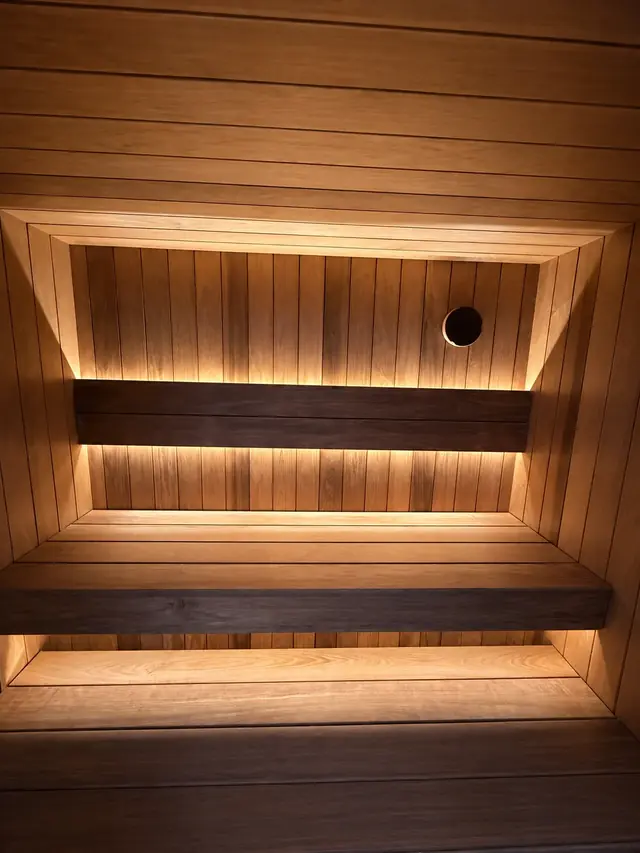
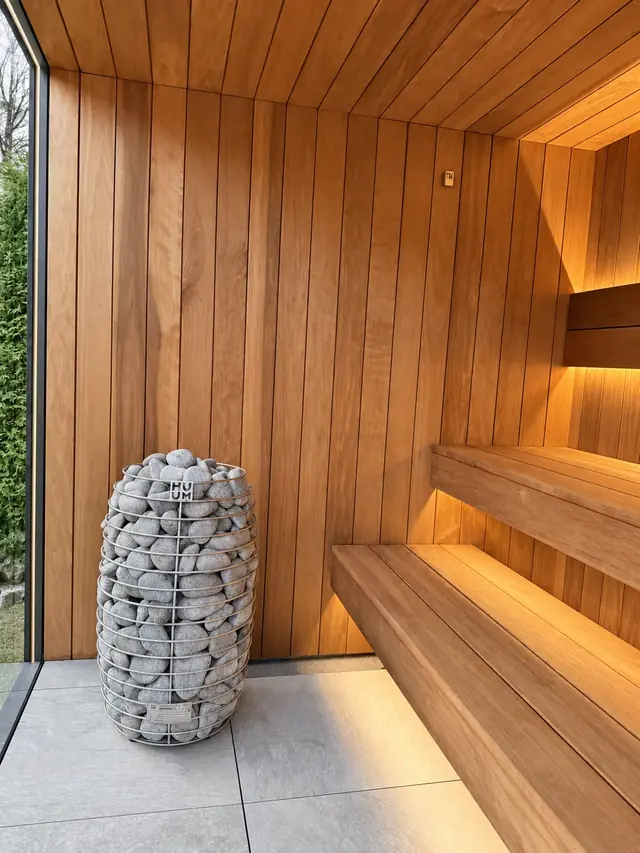
Look at the Aura interior photograph as if you were deciding where to sit. Follow the lines of the bench to the front edge, then look at the backrest and where the seating ends near the heater. These are places you might notice differently when sitting, leaning or shifting your feet. The photograph is useful for picturing that movement. It cannot establish the exact edge shape, surface texture or what the wood feels like after heating.[1][3]
If you can see a sample or a cabin, use a cool one to get a sense of the seating edge and how it meets the backrest. Ask for the owner's guidance for use in a heated cabin. Wood can get hot enough to burn, and the comparison with metal cannot tell you when a particular seat is safe to touch.
What to ask about the seat you will use
It helps to separate three questions in your enquiry. First, what is the actual bench material and finish? Second, what do the seat, front edge and backrest look like together? Third, what does the handover guidance say about using and caring for these surfaces? The answers may come from a written offer, a drawing and an owner guide respectively. A close-up of the wood is useful alongside those documents.[3][4][5]
Imagine taking a towel into the garden after work and sitting down for an unhurried round. Is there somewhere to put your feet in the position you prefer? Can you picture sitting upright as well as leaning back? Thinking through one ordinary visit helps you ask about the surfaces you will use instead of choosing from a colour name alone.
Choose where the pause belongs
Aura is the compact outdoor sauna with one dedicated sauna room. Aura Lounge adds a separate lounge. The two published sheets use the same words for the interior lining, so the more useful choice may be what you want to do between rounds. Perhaps you want a short walk straight into the sauna. Perhaps you want a separate spot to set down a book and stay a little longer. These are two possible evenings, not a claim that one bench runs cooler than the other.[3][4]
If one layout suits you, ask Aura Cabin to confirm the seat and backrest materials in your project offer and show you the relevant seating detail. A space that is easy to picture is also easier to ask precise questions about.
Sources & further reading
- Engineering Evaluation of Tactile Warmth for WoodObata et al., International Journal of the Society of Materials Engineering for Resources · Sources checked on
- Wood Handbook, Chapter 4: Moisture Relations and Physical Properties of WoodUSDA Forest Products Laboratory · Sources checked on
- Aura technical specifications · 18 October 2026Aura Cabin · Sources checked on
- Aura Lounge technical specifications · 18 October 2026Aura Cabin · Sources checked on
- Bench board SHP Thermo-aspenThermory · Sources checked on
Already have a place in mind?
A few thoughts can become your first project brief.