Follow the light before you follow the grain
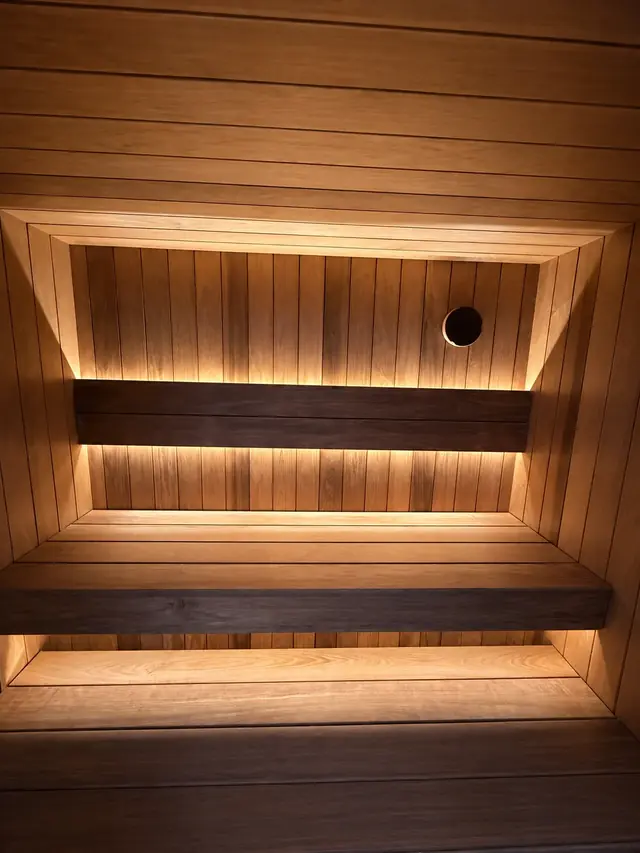
Start with the close-up of Aura. Above the dark band of the backrest, the light picks out narrow lines between upright boards. Below it, a separate bright patch makes the timber read differently. Look farther down and you can see the glow under the upper bench and the broad face of the board below it. Move your eye between those three areas and notice which lines stand out in each.[1][2]
Some of the lines are grain within a board. Others are joints between boards or the shadows made by an edge. They can look equally pronounced in a photograph, but they tell you different things. One is a feature of the wood; the other owes much of its appearance to how the pieces meet and where the light falls.
A thought experiment with a scrap of wood
Imagine a scrap of timber lying on a kitchen table. In this thought experiment, first light the whole table evenly. Then imagine a small lamp sending light almost along the surface of the scrap. The second arrangement makes little ridges and edges cast more visible shadows. You have not changed the wood or made deeper marks. You have made existing details easier to see.[2]
ERCO uses a similar distinction in its lighting design examples. Diffuse light models surface relief less strongly, while light arriving at a shallow angle can emphasize it. That explains why a board can look quiet in one image and more sharply drawn in another. The principle is useful for reading the sauna photo. It does not prescribe an angle or identify the fixture in the cabin.
A soft wall can still sit next to a bright spot
The Illuminating Engineering Society describes glare in relation to what your eyes have adapted to. A bright point against a dark background may draw your attention even if most of the room looks softly lit. Where the source sits in your field of view matters, along with its size and brightness. A light that is hidden from one seat might still be visible from another.[3]
Imagine sitting down and looking forward, then turning towards the door. Do you see the glowing timber, the light source itself, or a bright reflection? Those are different views of the same arrangement. If you get to see a cabin in person, look from the height where you will actually sit as well as from the doorway. A doorway photograph cannot answer both questions.
Compare the two pictures, then compare the moments
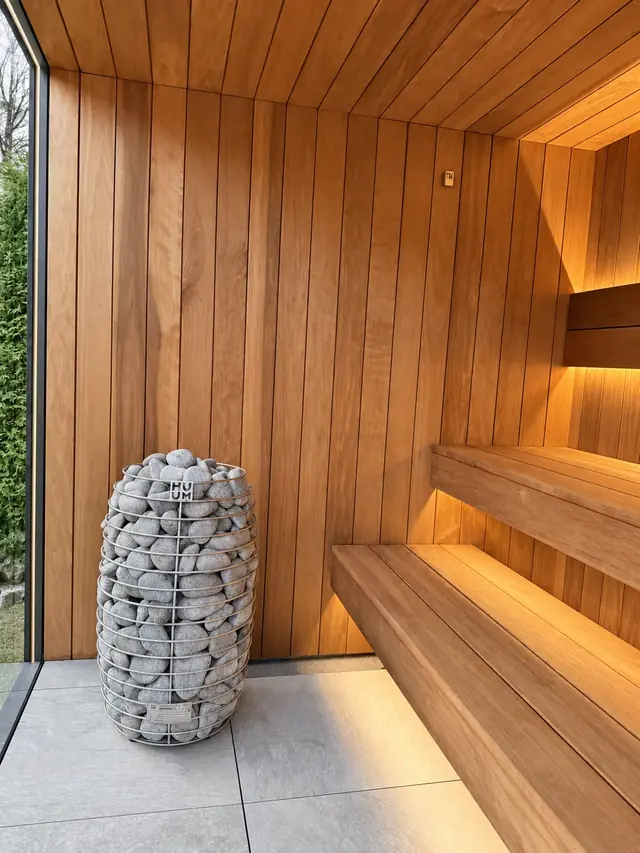
The Aura close-up is framed around the backrest and bench. The Aura Lounge sauna-room photo shows more of the scene: light on the timber at one side, the stone heater and floor, and daylight from the garden through the glazing. The wood remains the main interior surface in both images. What differs is how much of the room and outside light the picture includes.[1][4]
Imagine that same Lounge view when the garden has gone dark. The bands of light on the wood might then draw more attention than they do in the daylight photo. This is a scenario to picture, not a report from an evening visit. Exposure and white balance can change what you see on screen, so comparing these two photos cannot tell you which cabin is brighter or how its light will look at your site.
What the specification confirms
The technical sheets dated 18 October list thermally treated aspen as the interior lining and integrated LEDs for both models. That is a starting point for a conversation about a real material and a real feature. It does not tell you the colour temperature, light output, dimming, switching arrangement, or protection rating of a particular light fitting. Nor does it guarantee that every project is delivered exactly as photographed.[5][6]
Ask for the lighting arrangement in the offer for your chosen cabin. A labelled photo or sketch can help you understand which surfaces receive light, while the equipment information explains what is included. Keep those two pieces of evidence separate. The photo can show how a wall looks; it cannot establish which replacement component your installer should use.
Walk the room in three small steps
Picture coming in with a towel, finding your place on the bench and then getting up to leave. At the door, look at the route to the seat. From the bench, see where your eye rests and whether the source or a reflection catches it. On the way out, consider what you can see as you move towards the door. This little sequence is more useful than asking only whether the room looks cosy.[3][5][6]
If you choose Aura Lounge, add a fourth stop: the separate lounge. Ask which lights you can control in each room and whether the proposed arrangement suits both a pause and the walk back to the sauna. These are questions to put to Aura Cabin, not features inferred from the photos.
Choose the evening you want to picture
The compact Aura gives you a dedicated sauna room. Aura Lounge adds a separate place to spend time between rounds. You might want the simple walk from house to bench, or you might like putting down a book in another room before going back into the warmth. Both can begin with the same sight: the light falling across a few boards and bringing out something you missed in daylight.[5][6]
If that sounds like your kind of evening, ask Aura Cabin to show the lighting and lining together for the model you are considering. A useful conversation can start with one clear question: what will I see from the spot where I plan to sit?
Sources & further reading
- Aura sauna · backrest lighting detailAura Cabin · Sources checked on
- Emphasising materials with lightERCO · Sources checked on
- Glare · Lighting glossaryIlluminating Engineering Society · Sources checked on
- Aura Lounge · sauna room and heaterAura Cabin · Sources checked on
- Aura technical specifications · 18 October 2026Aura Cabin · Sources checked on
- Aura Lounge technical specifications · 18 October 2026Aura Cabin · Sources checked on
Already have a place in mind?
A few thoughts can become your first project brief.